

Fused vs stained vs blown glass: which should you commission?
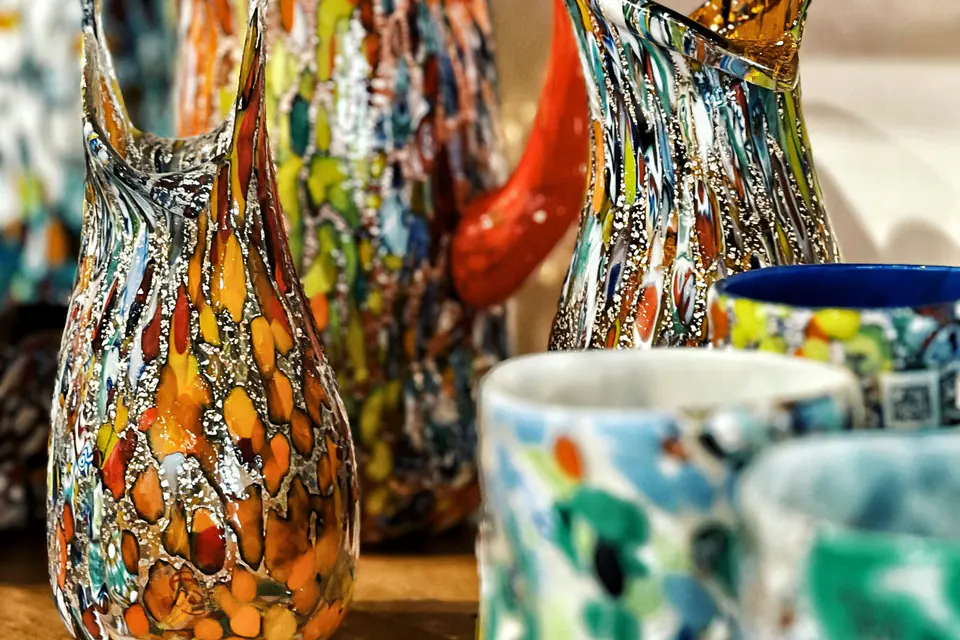
Pick the technique by what you want to end up with. Stained glass is cut pieces joined with lead or copper foil, which makes it the choice for windows, door panels, suncatchers and lamps. Fused glass is pieces stacked and melted together in a kiln, good for flat or gently curved work like plates, coasters, tiles, wall panels and jewellery. Blown glass is shaped from molten glass on a blowpipe, and it's how you get vessels: vases, bowls, ornaments and lighting. Each needs different equipment, so the maker you hire depends on the technique.
The three techniques at a glance
| Stained glass | Fused (kiln-formed) glass | Blown glass | |
|---|---|---|---|
| How it's made | Cut sheet glass joined with lead came or copper foil and solder | Cut glass stacked and heated in a kiln until it bonds | Molten glass gathered on a blowpipe and shaped while hot |
| Key equipment | Cutters, grinder, soldering iron; a kiln for painted detail | Glass kiln | Furnace, glory hole (reheating furnace), annealer |
| Typical pieces | Windows, door and cabinet panels, lamps, suncatchers | Plates, bowls, coasters, tiles, wall art, jewellery | Vases, bowls, glasses, ornaments, pendant lights |
| Look | Clear lines between pieces, light passes through | Smooth, merged colours, no visible joins | Seamless 3D forms |
Stained glass
Stained glass artists cut sheet glass to a pattern, grind the edges, and join the pieces. Lead came is the traditional method and the usual choice for exterior windows, because the cemented panel is strong and weatherproof. Copper foil, the method Tiffany started, suits small, fiddly shapes and 3D work like lampshades [1]. Faces, lettering and shading are painted on with glass paint and fired in a kiln.
Commission it for: windows, transoms, door panels, room dividers, lamps, panels to hang in a window.
What drives the price: size, number of pieces, the glass, painted detail and fitting. Our post on what a custom stained glass window costs has published per-square-foot ranges.
Fused glass
Fusing is "warm glass": the glass is heated in a kiln rather than worked by hand in a flame. Approximate kiln temperatures for common fusing glass are [2]:
- Slumping (bending a fused blank over or into a mould): 1150–1250 °F (621–676 °C)
- Tack fusing (pieces stick but keep their shape and texture): 1350–1375 °F (732–746 °C)
- Full fusing (pieces melt into one smooth layer): 1450–1490 °F (760–787 °C)
Every glass in a fused piece has to be compatible, or stress builds up as it cools and the piece can crack. Bullseye Glass, a major maker of fusing glass, says its fusible glasses are factory-tested for compatibility with each other, and that a matching COE number alone doesn't guarantee two glasses are compatible [3]. Ask your maker which glass system they use.
If the piece will hold food, ask about that too. Bullseye says some of its colours contain lead or cadmium and recommends capping food-bearing surfaces with clear glass. It also says its testing isn't a guarantee of food safety, and it suggests treating fused glass like fine china: dishwashers can etch it over time and microwaves can crack it [3].
Commission it for: serving plates, bowls, coasters, house numbers, splashback tiles, wall panels, memorial pieces, jewellery.
Blown glass
Glassblowing is "hot glass". Wikipedia's overview of the craft gives a working temperature of around 1,090 °C (2,000 °F), with most shaping between 870 and 1,040 °C (1,600 and 1,900 °F) [4]. The maker gathers glass on a blowpipe, inflates and shapes it, and reheats it in the glory hole between steps. The finished piece then cools slowly in an annealer over a few hours to a few days, so it doesn't crack from thermal stress [4]. Free-blown pieces are shaped by hand. Mould-blown pieces take their form from a mould, which helps when you need several matching pieces [4].
Commission it for: vases, bowls, drinking glasses, ornaments, pendant shades, sculptural pieces.
Good to know: a hot shop costs a lot to run, and many blowers work in batches. Matching sets and exact dimensions are harder than one-off organic shapes, so say up front how much variation you can accept.
Lampwork and etching
Two related techniques often come up in the same conversation:
- Lampwork (flameworking) shapes glass rods and tubes in a torch flame. It's used for beads, small figures and pendants.
- Etching and engraving decorate finished glass: sandblasting, acid etching, or a laser. A CO2 laser can frost a design onto glass from a digital file, which suits names, logos and one-off gifts.
How to choose
- Light through a window or door? Stained glass.
- Something flat or shallow you'll use or hang? Fused glass.
- A vessel or a 3D form? Blown glass.
- Lettering or a logo on an existing glass? Etching or engraving.
- Not sure? Describe the result you want and let makers suggest the technique in their bids.
Commissioning it
On The Spool List, makers list their equipment, so a job can reach makers with a glass kiln, a hot shop or a laser. Post your idea once, free, with the size, colours, where it'll go, photos or sketches, and your deadline. Verified makers bid with a price and a timeline. You pay when you accept, the payment is protected, and the maker is paid when you confirm delivery. See how it works, our price guide, and the glass work market.
Post your glass commission free.
FAQ
Is fused glass the same as stained glass?
No. Stained glass joins separate pieces with lead or foil. Fused glass melts the pieces together in a kiln, so there are no metal lines.
Can fused glass go in a window?
A fused panel can hang in or in front of a window. For a glazed window, ask the maker and a glazier about size, safety glass rules and fitting where you live.
Is blown glass dishwasher safe?
It depends on the glass and the piece. Ask the maker. Many recommend hand washing for handmade glass.
Which is the cheapest?
It depends on the piece. Small fused items and suncatchers are often the most affordable way to commission glass, but the bids you get are the real answer.